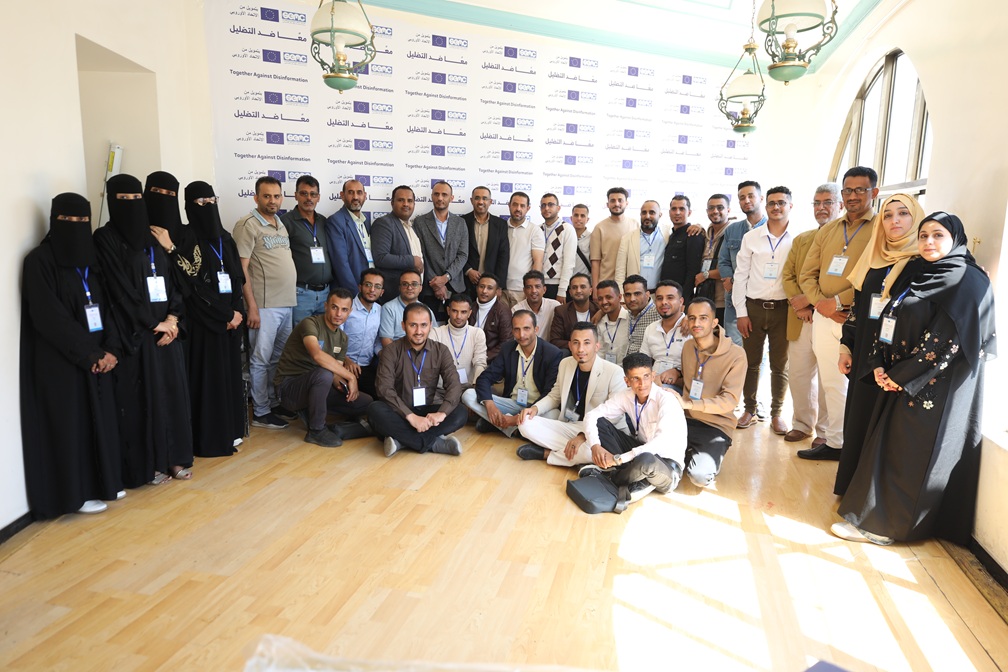
Participants in the specialized workshop on fact-checking and combating disinformation, held in Taiz over the past two days, reached a comprehensive strategy aimed at reducing disinformation in Yemen through effective partnerships between independent media institutions and outlets, fact-checking platforms, and all professionals working in the media sector.
The strategy, developed by more than thirty male and female journalists attending in person, along with dozens participating online, includes capacity building, skills development, awareness-raising, monitoring and auditing, enhanced cooperation among media institutions, and the development of policies related to professional coverage and combating disinformation.
The participants in the workshop, organized by the Studies and Economic Media Center (SEMC) with support from the EU Delegation to Yemen, approved a Charter of Principles to Combat Disinformation. The charter is based on respect for truth and adherence to credibility and includes core principles and goals aimed at promoting transparency, professional responsibility, protecting the public from false information, rejecting hate speech, violence, and incitement, and supporting independent and professional media as a pillar of societal stability.
The workshop served as a think tank for dozens of journalists from independent media outlets, fact-checking platforms, digital media experts, and various actors from multiple governorates. They engaged in in-depth discussions focusing on unpacking several critical issues, including: “The Current Media Landscape,” “The Phenomenon of Media Disinformation in Yemen,” and “The Responsibility of the Media in Confronting Misinformation” after a decade of war that has gripped the country.
Participants reached several conclusions, most notably that there is “no shared narrative among independent media workers and fact-checking platforms to confront disinformation, and that media discourse remains fragmented across multiple actors.”
Attendees revealed the widening impact of disinformation within society, leading to serious harm both to the media and to the public. They highlighted weak verification methodologies in newsrooms, limited use of modern fact-checking tools, growing distrust in media outlets, and the increasing spread of inaccurate and misleading news via digital platforms.
Participants also presented numerous examples illustrating the diverse risks of media disinformation on community security, national identity, the situation of women and children, education, mental health, and the rise of hate speech and polarization.
Discussions underscored the need for independent media institutions to have a safe and supportive environment that guarantees professional and independent work and enables them to fulfill their vital role in serving the public interest. Participants stressed the importance of addressing challenges related to misleading information and the chaos of digital content that does not adhere to media ethics.
The diversity of participants, from various media platforms, fact-checking entities, and experts, was a key strength of the workshop. Skilled facilitators guided the process to ensure realistic and practical outputs. The discussions produced a roadmap forming a foundation for collaboration and sustainable joint action, strengthening common ground among journalists, media outlets, and fact-checking platforms.
The workshop employed clear and innovative methodologies that helped participants identify gaps, define challenges, and diagnose essential needs for rebuilding trust between media institutions and the public, a public exposed daily to a flood of misleading, false, and malicious information. This enabled participants to design more effective, realistic, and sustainable solutions and alternatives.
The workshop concluded with unanimous approval by participants of the strategies and mechanisms they had developed, representing vital outcomes and valuable proposals that outline how they will build a joint entity to confront disinformation, and the programs that will help transform goals into tangible and visible results.
Participants recommended supporting initiatives aimed at developing journalists’ fact-checking skills, enhancing cooperation between media institutions and local and international fact-checking platforms, and strengthening internal procedures within media organizations for verification before publication.
They also emphasized the importance of investing in AI tools and technologies to help detect fabricated content, launching awareness programs targeting youth, women, and students to limit the impact of disinformation, and encouraging donors to support monitoring and media literacy projects.
COMMENTS