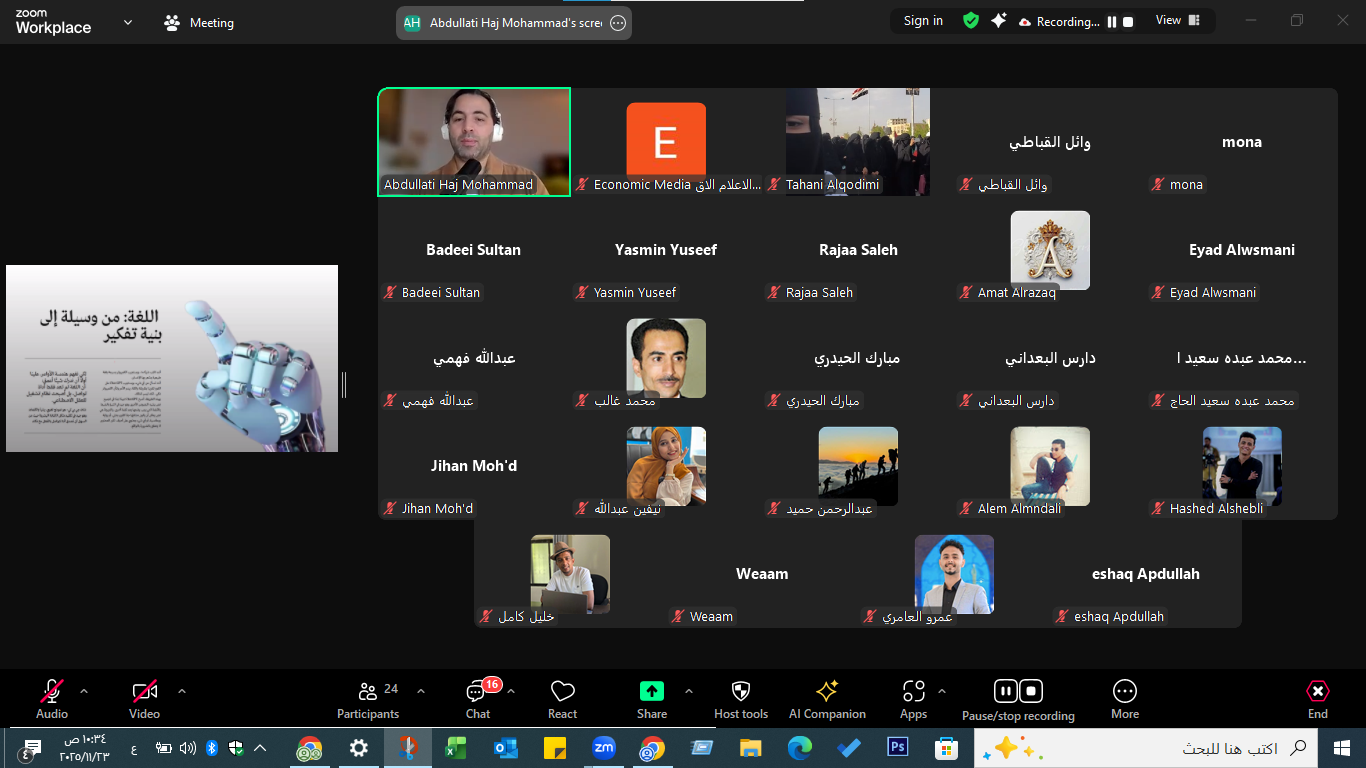
The Studies and Economic Media Center (SEMC) concluded today, Tuesday, the second training workshop within the program to support the sustainability of independent media institutions in Yemen. The workshop, titled “Audience Analysis and Digital Expansion Strategies for Independent Media Outlets,” was conducted in partnership with the National Endowment for Democracy (NED).
The four-day online workshop brought together 22 male and female journalists representing 22 independent media outlets across eight Yemeni governorates. It aimed to enhance participants’ capacity to understand digital audience behavior, design data-driven expansion plans based on professional methodologies and translate analytical findings into practical tools that can be implemented inside newsrooms.
The workshop covered a range of applied training modules, including exercises on building audience personas, analyzing digital interaction patterns, hands-on applications of prompt engineering for content journalists, designing tailored content products, and developing community growth campaign plans. It also included practical sessions on creating reference pages and entity maps for thematic files, tools designed to help institutions transform audience data into actionable insights.
The sessions further featured evaluative exercises using the participants’ own materials. Each media outlet reviewed its texts through the lens of quotability, clarity of ideas, and editorial requirements, rewriting selected excerpts to make them more compatible with language-model processing. As a result, the teams produced practical outputs such as bulletin headlines, ready-to-use prompt libraries, preliminary growth campaign concepts, and draft reference page layouts.
Mohammed Esmail, the SEMC Executive Manager, emphasized that this workshop comes as part of SEMC’s ongoing efforts to enhance the capacities of media institutions and outlets in digital transformation and modern media production. He noted that understanding audiences is no longer an optional but an urgent necessity, stressing that data-analysis tools enable newsrooms to make more precise and effective editorial decisions, expand their digital presence, and reinforce their professional and financial sustainability.
For his part, Abdullatif Haj Mohammed, the workshop trainer and CEO of the Journalism and Artificial Intelligence Network in the Middle East and North Africa, explained that the sessions addressed the rapid transformations in the digital environment and the responsible use of AI tools to support quality, analysis, and innovation. He highlighted the importance of cultivating an informed relationship between journalists and technology so that digital tools serve professionalism rather than replace it.
At the conclusion of the workshop, participants praised the quality of the content and the depth of the practical exercises, affirming that the knowledge gained will influence editorial policies and publishing strategies within their media institutions and outlets. Journalist Ishaq Al-Humairi, one of the participants, expressed his appreciation, saying:
“The workshop was extremely useful and enriching. It opened new prospects for me as a journalist to develop my skills and improve the performance of the institution I work with. The workshop stood out for its focus on journalists’ needs, from clarifying AI concepts and prompt engineering to understanding audiences and building bulletin plans and search-engine-optimized keywords.”
It is worth noting that the Studies and Economic Media Center (SEMC) is a civil society organization working toward a successful and transparent Yemeni economy by raising awareness of economic and developmental issues, supporting transparency and good governance, and fostering professional and high-quality media.
COMMENTS