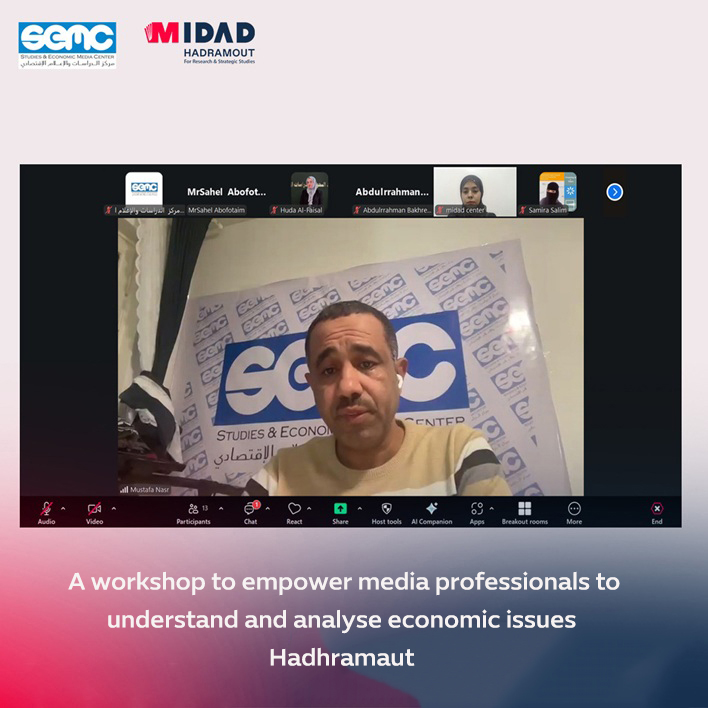
The Studies and Economic Media Center, in partnership with the Midad Hadhramaut for Research & Strategic Studies, launched a specialized training workshop on Wednesday, January 14, 2026, aimed at empowering journalists to better understand and analyze local economic issues. The workshop is being held virtually via Zoom over the workshop of two days, with the participation of journalists and media professionals interested in economic affairs in Hadramout Governorate, eastern Yemen.
The training seeks to strengthen participants’ knowledge of economic journalism and its core tools, with a particular focus on producing professional economic news and reports using clear and accessible language. The workshop emphasizes simplifying complex economic topics and presenting them in ways that resonate with audiences and reflect their daily realities.
The program focuses on enhancing journalists’ ability to systematically assess the local economic context, understand and analyze key economic indicators, and translate them into accurate and responsible media content. This approach aims to contribute to raising public awareness and supporting informed public dialogue on livelihood and development-related issues in Hadramout.
The workshop also includes an introductory component on the concept and societal importance of economic journalism, highlighting the direct link between economic policies and citizens’ lives. In addition, participants receive practical training on simplifying commonly used economic terms such as inflation, the public budget, exchange rates, and unemployment and contextualizing them within the local environment to help audiences better understand their implications.
Commenting on the initiative, Abdulkhaleq Al-Haddar, Head of the Midad Hadhramaut for Research & Strategic Studies, stated that the partnership agreement with the Studies and Economic Media Center reflects a shared commitment to strengthening collaboration in research and media training, and to enhancing journalists’ capacities in covering economic and development issues. He noted that this partnership contributes to promoting transparency and accountability through professional and knowledge-based economic media content.
Mustafa Nasr, Head of the Studies and Economic Media Center and trainer of the workshop, explained that the training is part of ongoing efforts to build journalists’ skills in producing high-quality economic reporting capable of interpreting data and discussing economic policies in ways that reflect the lived realities of citizens. He emphasized the importance of economic journalism given its direct impact on people’s daily lives.
One of the participants, political researcher and analyst Huda Faisal, described the workshop as valuable and timely, noting that it provides journalists and media practitioners with practical tools for economic journalism and supports the production of clear, professional, and audience-oriented content.
COMMENTS