Minister of Water and Environment Tawfiq Al-Sharjabi announced that the ministry is seeking to secure $20 million in funding from the Climate Adaptation Fund for the Wadi Al-Dhabab Basin, in addition to coordinating with the World Bank under its new water sector project. These efforts come within an active framework to unify stakeholders and develop root and sustainable solutions to the escalating water crisis in the governorate.
Speaking at the expanded meeting organized today in Taiz by the Studies and Economic Media Center (SEMC) in partnership with the local authority and the Local Economic Development Council, Al-Sharjabi stated that the seawater desalination project from the city of Mocha represents the long-term strategic solution to Taiz’s water crisis. He noted that the ministry is working to revive the project in coordination with partners in the Kingdom of Saudi Arabia.
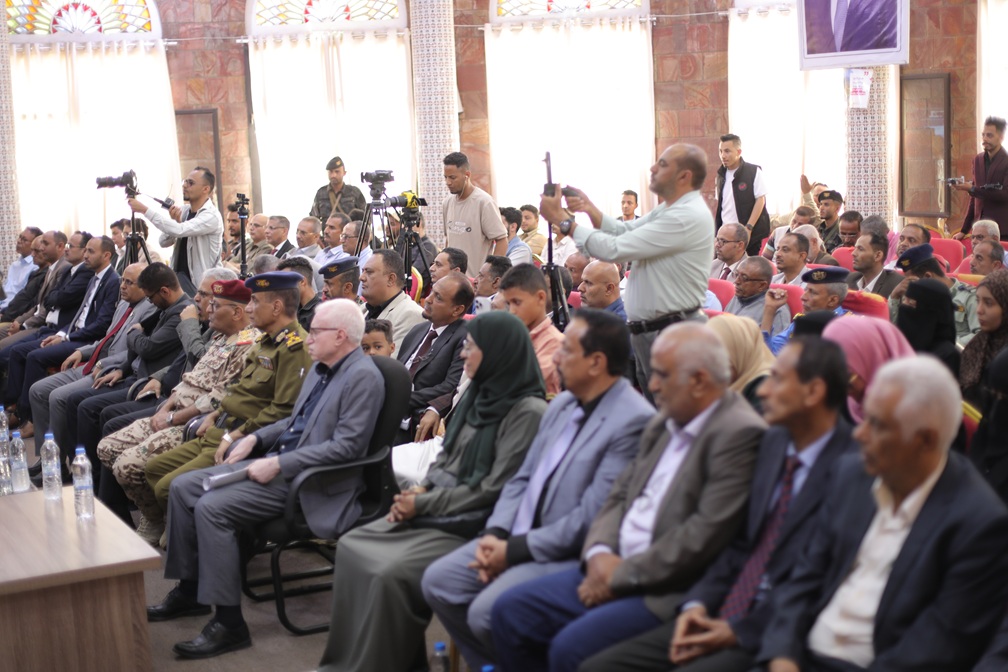
The meeting, which brought together executive office directors, academics, experts, journalists, and military and security leaders, focused on strategic solutions to the crisis. The minister reaffirmed the government’s commitment to placing Taiz’s water file at the top of its priorities, noting that the crisis affects more than 600,000 people, while network coverage has dropped to below 29 percent, requiring urgent and comprehensive intervention.
He stressed that Taiz’s water crisis is no longer merely a service challenge but has evolved into an issue of human security, social stability, and economic development that cannot withstand further delay. He attributed the worsening situation to the repercussions of the Houthi’s coup and the closure of key water sources, alongside infrastructure deterioration, declining investments, and the natural depletion of groundwater reserves.
Al-Sharjabi also indicated that the ministry, in partnership with UNICEF, has initiated a package of specialized studies to serve as references for upcoming interventions. These include a study on Integrated Water Resources Management (IWRM), a study on emergency water supply infrastructure, a remote sensing study to monitor groundwater reserves, and a climate vulnerability assessment to address the impacts of climate change.
For his part, Taiz Governor Nabil Shamsan affirmed that the meeting marks the beginning of a sustained participatory track to address the water issue, based on coordinated efforts between the government, local authority, and local and international organizations. He emphasized that resolving the crisis fundamentally requires adopting sustainable strategic solutions, foremost among them seawater desalination, as the most realistic and secure option to ensure a stable water source for the governorate, alongside emergency measures to ease current suffering.
The governor stressed the importance of intensifying coordination with partners in Saudi Arabia to revive the desalination project, whose studies had previously been completed, noting that the local authority is working with all relevant stakeholders to return the project to implementation as a strategic rescue initiative for the governorate. He also called on journalists, business leaders, political parties, and civil society organizations to positively engage in advocacy efforts and support strategic projects, particularly the desalination project, as a sustainable solution to end Taiz’s water crisis.
Meanwhile, the Head of the Local Economic Development Council, Shawqi Ahmed Hayel, called for comprehensive solutions to end chronic suffering, warning that the crisis has moved beyond an emergency problem to become a real threat to economic, health, and social stability in the governorate. He stressed that reliance on partial measures is no longer viable and that transitioning from crisis management to crisis resolution requires decisive leadership and unified positions, reiterating that seawater desalination represents a realistic and sustainable strategic option.
In the same context, Mustafa Nasr, Chairman of SEMC, underscored that the water crisis in Taiz has become a matter of human security and comprehensive development. He called for a shift from temporary fixes to science-based strategic planning and for building institutional and societal consensus around clear priorities, including desalination projects, the construction of dams and water barriers, and strengthening public–private partnerships.
Taiz Deputy Governor for Services Rashad Al-Akhali presented a working paper reviewing the current status of the water system and the measures taken, including the establishment of a higher committee and operations room for emergency management, support to the Local Water Corporation to rehabilitate networks and reduce losses, and efforts to accelerate vital projects—most notably the Sheikh Zayed Project—alongside strengthening partnerships with donors.
Additionally, the Director General of the Local Water and Sanitation Corporation branch, Eng. Wathiq Al-Aghbari, delivered a technical presentation outlining operational challenges, particularly limited water sources, damaged infrastructure, and high operating costs. He also reviewed key aspects of the desalination project study, including site selection, production capacity, financing mechanisms, and implementation phases.
The working paper session concluded with a presentation by Ahmed Shamsan, Director of the General Authority for Water Resources branch, who noted that groundwater extraction rates exceed natural recharge levels, leading to depletion and longer supply intervals. He emphasized that strategic solutions include rainwater harvesting, artificial recharge of basins, and seawater desalination using modern technologies and renewable energy, as well as strengthening regional and international partnerships to support these efforts.
The meeting concluded with remarks by Nabil Jamil, Director of Planning and International Cooperation in Taiz, who highlighted the local authority’s efforts to place the water issue at the forefront of priorities for the coming phase. He noted that the outcomes of the meeting will be incorporated into planned discussions with donors in the coming months.
COMMENTS