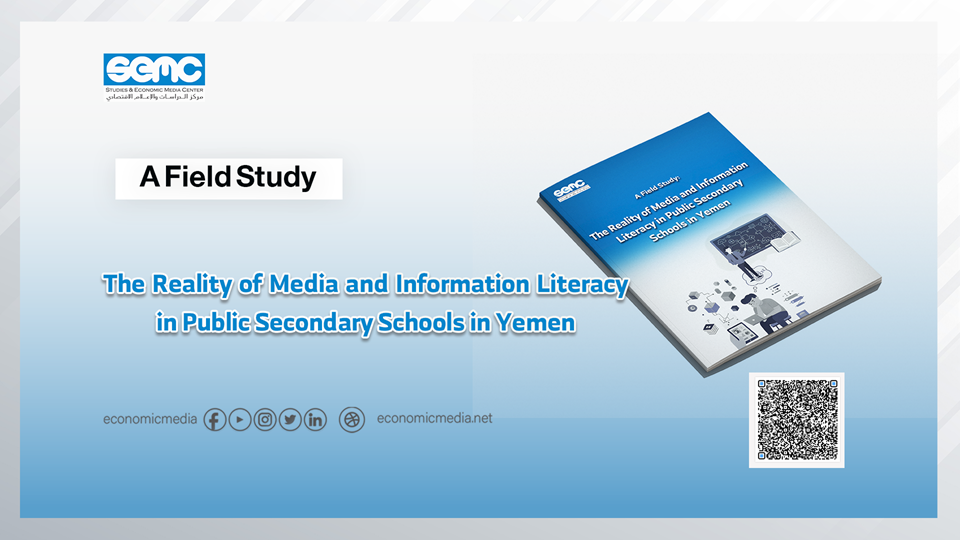
Field Study by SEMC: Low Awareness of “Media Literacy” Skills Among Yemeni Teachers and Students Opens the Door to Misinformation and Hate Speech
A recent field study launched by the Studies and Economic Media Center on Saturday, January 3, 2026, revealed a significant knowledge gap and a general lack of awareness among teachers and students regarding media and information literacy concepts in Yemeni secondary schools. The study emphasized that the absence of these skills poses a real challenge, leaving the educational environment vulnerable to digital misinformation and the spread of hate speech.
The study, conducted in the governorates of Taiz and Hadramout, aimed to assess the state of “media literacy” and identify the gaps facing the educational field. It employed a mixed research methodology combining field surveys with rigorous statistical analysis.
Results showed that 63.4% of curricula completely lack sufficient content on media literacy, while the majority of teachers confirmed that textbooks provide no mechanisms to teach students how to engage with media effectively. Reflecting the scale of the gap, the study revealed a widespread confusion among educators between the concepts of traditional “educational media” and “media literacy” as critical thinking skills.
Regarding information consumption, the study found that social media platforms top students’ sources of information at over 80%, while news verification habits remain very low, with only 11% of students claiming they always check the accuracy of what they read. This skill gap has left the educational environment exposed to misleading information, which 83% of teachers reported encountering directly in their work.
The risks extend beyond misinformation to social behavior, as 51.2% of teachers reported observing instances of hate speech and cyberbullying among students, attributing this to a lack of awareness of digital etiquette and responsible online conduct.
Commenting on the findings, Dr. Mujib Al-Humaidi, the lead researcher, said:
“The results reached sound the alarm; we are facing a generation fully immersed in digital spaces without possessing mental filtering tools.”
Al-Humaidi emphasized that, “Media literacy today is not an intellectual luxury but a national and educational necessity to shield students and teachers from disinformation campaigns and hate speech that tear apart the social fabric.”
He added, “The study found that 80.5% of teachers consider insufficient training as the primary barrier. Therefore, the solution begins with requalifying teachers and updating curricula to match the times, rather than leaving our children at the mercy of social media algorithms.”
For his part, Mohammed Ismail, Executive Director of the Economic Media and Studies Center, explained that the study provides a scientific foundation for policymakers to adopt clear educational policies. He noted that the center has already begun designing practical interventions, including specialized teacher training and awareness sessions within schools based on these findings.
The study concluded with a set of recommendations: integrating media and information literacy concepts into school curricula and activities, implementing intensive training programs for teachers in critical thinking and information verification skills, developing interactive educational materials tailored to the Yemeni school environment, and enhancing partnerships between educational institutions, media outlets, and civil society organizations to produce purposeful awareness content that promotes the importance of media and information literacy.
The full study is available for viewing and download at the following link
COMMENTS