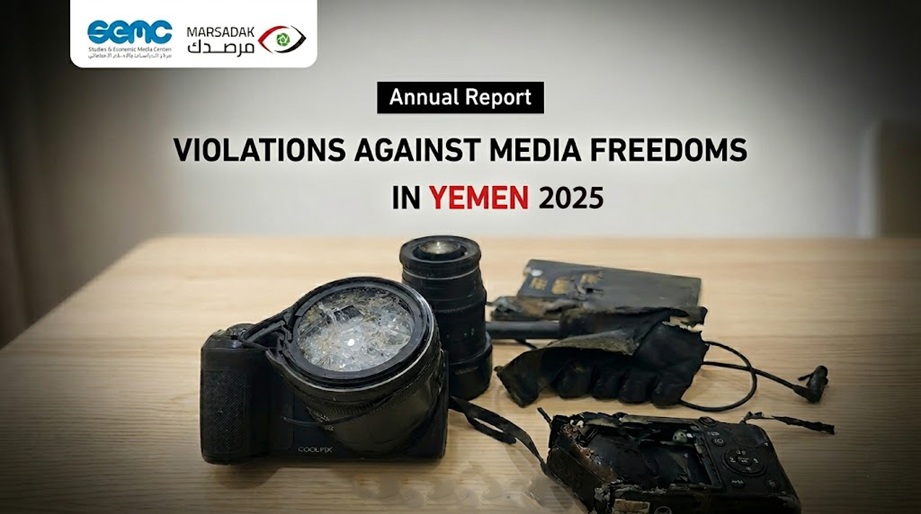
This report documents the state of media freedom in Yemen during 2025, amid an ongoing conflict and deep institutional fragmentation. Journalists continued to work in one of the world’s most dangerous environments for media activity, under escalating violations and in the absence of accountability. The report is based on a multi-source monitoring and documentation methodology adopted by the Yemeni Media Freedoms Observatory (Marsadak), drawing on direct testimonies, field data, and open-source information.
Throughout the year, the Marsadak documented a series of grave violations totaling more than one hundred incidents. These included 15 killings, 3 injury cases, 30 arbitrary arrests and detentions, several of which involved enforced disappearance for varying periods before the detainees’ whereabouts were disclosed, along with 27 interrogations and prosecutions, 8 threats, 5 cases of pursuit and prevention from filming, 11 incitement cases, and 9 violations targeting media institutions.
Concerning trends also emerged in the targeting of lawyers and defenders of journalists. Lawyer and human rights defender Abdulmajeed Sabra remains detained in Houthi prisons since September 2025, signaling an expansion of repression to include the legal protection system associated with media freedom.
The data indicate that arbitrary detention and enforced disappearance were among the most prominent tools of repression used to silence journalists, alongside the increasing use of the judiciary as a means of pressure. These included prosecutions based on vague charges, referral of publication-related cases to incompetent courts, and burdensome legal procedures. Administrative and security restrictions also continued, including prior permit requirements for field reporting in some areas, obstruction of coverage, and website blocking, reflecting a systematic trend toward controlling the media space.
The year also witnessed an escalation in the targeting of women journalists through campaigns of incitement, defamation, and threats, in addition to discriminatory restrictions on freedom of movement. These included requirements in some areas for women to be accompanied by a mahram (male guardian), limiting their ability to carry out their work independently. Violations also extended to the digital sphere, where journalists faced harassment and prosecution over their social media activity.
The report demonstrates that these violations were not isolated incidents, but part of a systematic pattern practiced by various parties to the conflict to varying degrees, amid a lack of accountability and ongoing impunity. It also reflects the decline of independent media, growing fragmentation, and the erosion of professional solidarity within the media sector.
The report found that the Yemen’ IRG was the leading perpetrator of media freedom violations during 2025, followed by Ansar Allah (the Houthis), and then authorities affiliated with the dissolved Southern Transitional Council (STC). This does not indicate a lower level of violations in Houthi-controlled areas; rather, it reflects the group’s tight security grip over journalists and citizens alike, effectively turning those areas into near-closed media environments.
The report clarifies that the IRG of Yemen committed the highest number of media freedom violations during 2025, followed by the Ansar Allah group (Houthis) and then authorities affiliated with the Southern Transitional Council (STC). This does not indicate a decrease in the volume of violations in Houthi-controlled areas; rather, it reflects the severe security grip the group maintains over both journalists and citizens, effectively turning those regions into media-tight environments.
To provide a clearer picture, the cumulative data for the period between 2015 and 2025 shows that Marsadak documented a total of 2,675 violations. The Ansar Allah group (Houthis) topped the list of violators with 1,894 violations, followed by the Yemen’ IRG with 284 violations. Additionally, 101 violations were attributed to the Southern Transitional Council, 37 violations were committed by the Saudi-led Coalition, and 28 violations were attributed to Al-Qaeda. Conversely, 118 violations were documented against unknown parties, while 213 violations were committed by influential figures, individuals, and other unidentified entities.
The report concludes that the continued targeting of journalists, combined with the absence of accountability and the weakness of an independent and fair judiciary, poses a direct threat to freedom of opinion and expression in Yemen. It undermines society’s right to access information and makes 2025 a pivotal year requiring serious international engagement, as well as urgent legal and institutional reforms to ensure the protection of journalists and end systematic abuses against them.
This report is not intended merely as a statistical record. Rather, it seeks to provide a comprehensive reading of the media landscape in Yemen over a full year of violations, through pattern analysis, testimonies, and highlighting the human and societal impact of these practices. It aims to serve as both a documentary and analytical reference reflecting the reality faced by Yemeni journalists, and summarizing a media sector besieged by fear, burdened by restrictions, yet still striving to survive and endure despite immense challenges.
To read the full Report

COMMENTS