
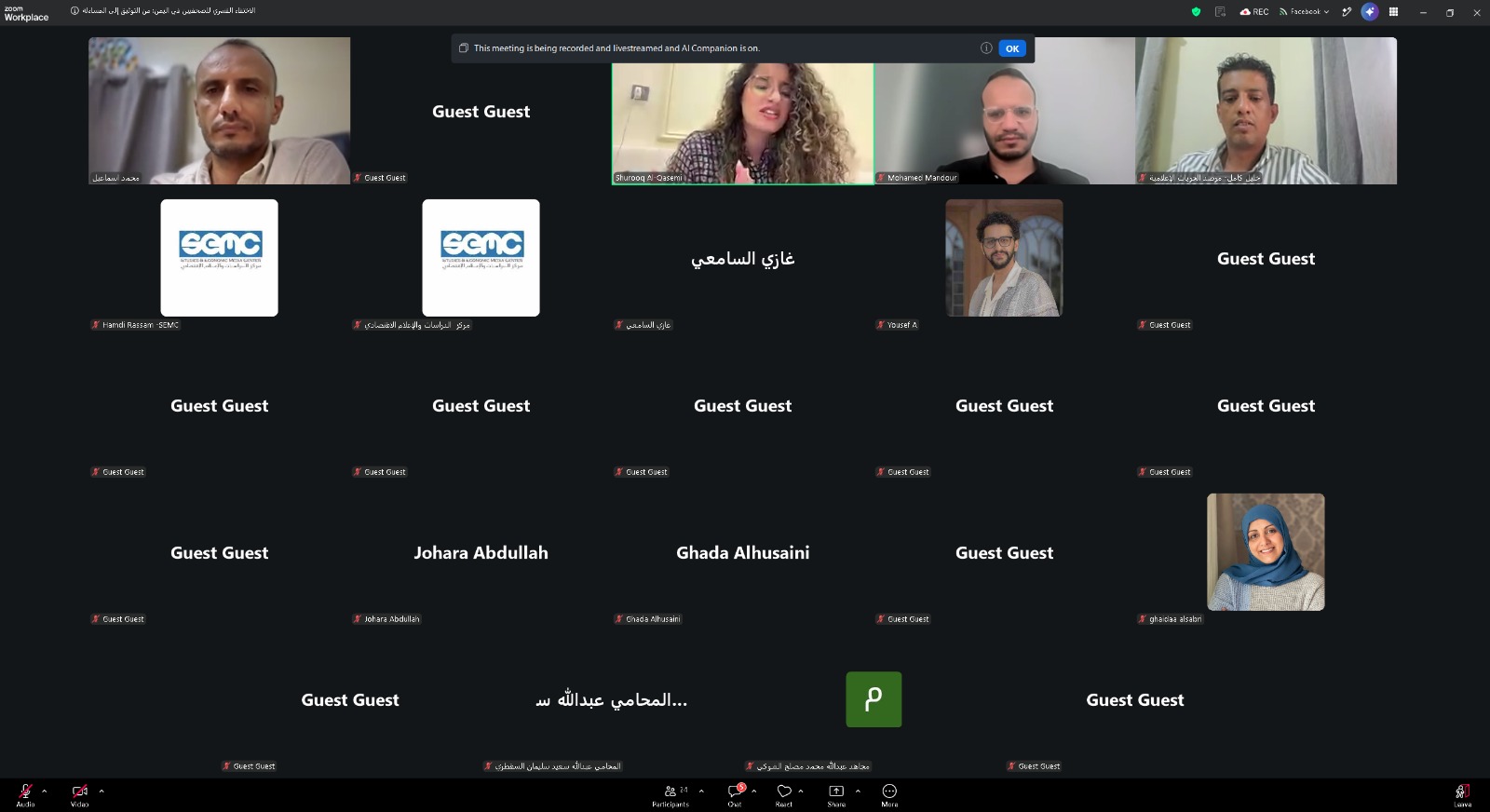
Journalists, human rights advocates, and experts in human rights have called for unified efforts to document cases of enforced disappearance of journalists in Yemen, the establishment of a shared database, and the activation of national and international accountability mechanisms. They stressed the importance of protecting journalists and ensuring the right of victims and their families to truth and justice.
The calls were made during a discussion webinar organized today, Sunday, by the Yemeni Media Freedoms Observatory “Marsadak,” affiliated with the Studies and Economic Media Center (SEMC), to mark the International Day of the Victims of Enforced Disappearances. The webinar, titled “Enforced Disappearance of Journalists in Yemen: From Documentation to Accountability,” brought together human rights experts, journalists, and representatives of civil society organizations.
In his opening remarks, SEMC Executive Manager Mr. Mohammed Esmail said enforced disappearance is among the gravest violations suffered by journalists and media workers in Yemen since the outbreak of the war. He noted that it not only deprives journalists of their freedom but also places them outside the scope of legal protection and deprives their families of information about their whereabouts or fate.
He explained that monitoring has revealed a recurring pattern that, in many cases, begins with the arrest of a journalist, followed by concealing the location of their detention and cutting off communication with them. He stressed that the impact of such practices extends beyond victims and their families to the entire journalism community by spreading fear and reinforcing self-censorship.
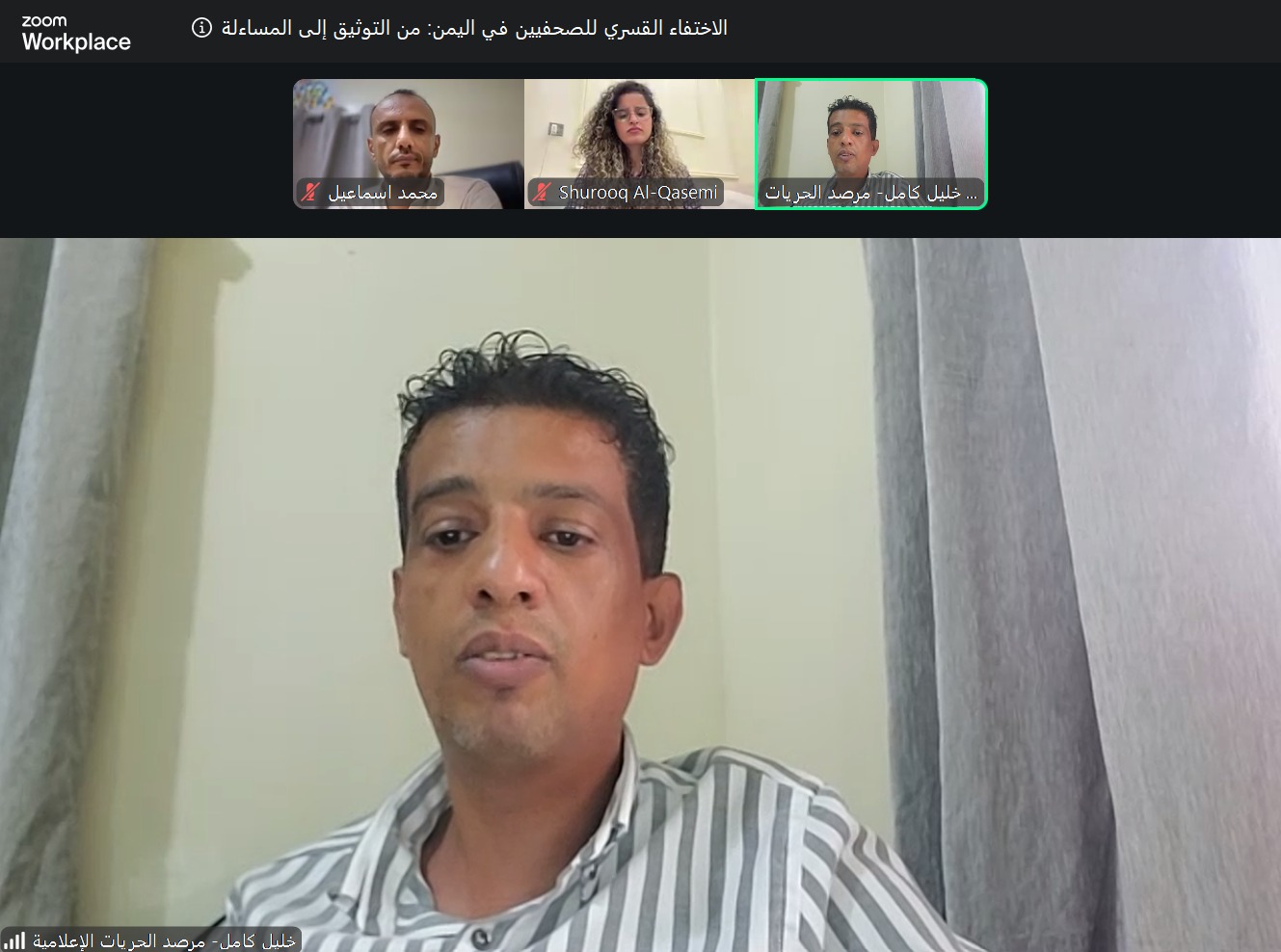
For his part, Mr. Khalil Kamel, Editor-in-chief of the Marsadak, outlined the far-reaching consequences of enforced disappearance, stressing that its impact extends to victims, their families, society, and press freedom. He explained that families of disappeared persons live with anxiety and uncertainty and bear the burden of pursuing legal remedies, while also facing threats or defamation.Mr. Kamel noted that fear of enforced disappearance restricts journalists’ work, adding that the Marsadak documented approximately 540 cases of arbitrary detention of journalists and media workers between 2015 and 2026, of which 235 turned into enforced disappearances, representing 43.5 percent. He stressed that impunity enables such violations to be repeated, noting that the Observatory has documented more than 2,700 violations since 2015, including 72 killings, with most cases lacking effective accountability.
Mr. Ghazi Al-Samie, Human Rights Officer at the Office of the United Nations High Commissioner for Human Rights in Yemen, said enforced disappearance is a complex crime that affects not only the disappeared person but also their family and society. He stressed that the crime remains ongoing as long as the person’s fate or whereabouts remain unknown.
He pointed to the multiplicity of armed actors, weak rule of law, the absence of a unified national register of detainees, and limited independent access to detention facilities as factors exacerbating the problem in Yemen.
Mr. Al-Samie called for the establishment of a unified national register of detainees, a ban on secret detention facilities, independent oversight of prisons, and protection for witnesses, families, and whistleblowers. He also called on Yemen to accede to the International Convention for the Protection of All Persons from Enforced Disappearance.
Meanwhile, Mr. Mohamed Mandour, a Senior Researcher for the MENA at the Committee to Protect Journalists (CPJ), said documentation is the first step toward accountability. He called for the creation of a unified database involving local and international organizations, journalists, and researchers, based on common methodologies and standards.
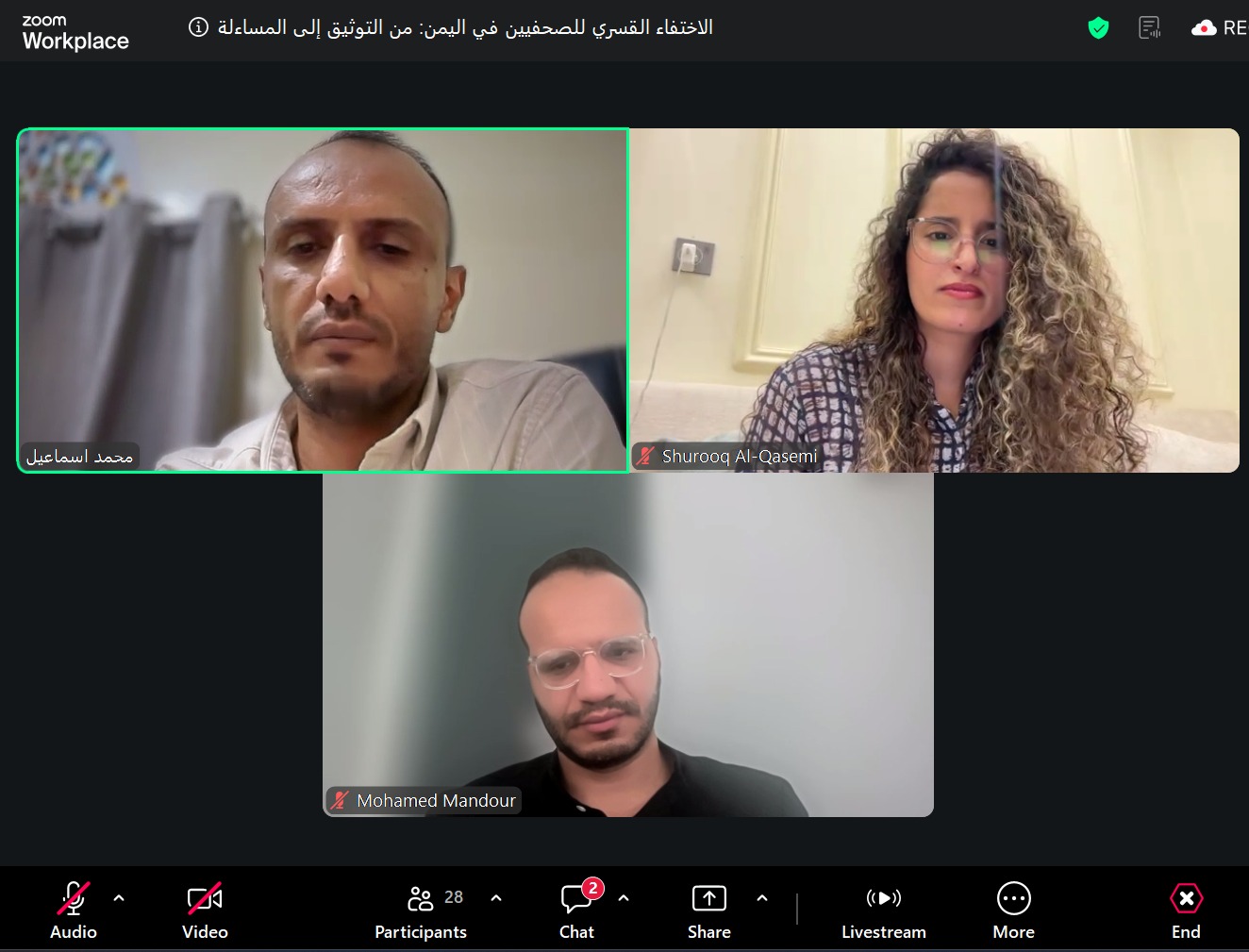
Mr. Mandour also called for the issue of forcibly disappeared persons to be included among the priorities of any future peace process or political arrangements. He stressed the importance of documenting the names of those involved, detention locations, and secret prisons in ways that would help build case files that could be used in future accountability and transitional justice processes.
Participants discussed the importance of harmonizing monitoring and documentation standards, distinguishing between arbitrary detention and enforced disappearance, protecting victims’ and sources’ data, and raising families’ awareness of the importance of reporting and documentation.
The webinar also featured testimony from journalist Issam Balghaith, who spoke about his experience of enforced disappearance and detention in prisons operated by the Houthi group. He described the fear and uncertainty he experienced, his deprivation of communication with his family, and the profound psychological impact such experiences leave on victims.
At the conclusion of the seminar, participants emphasized the importance of strengthening cooperation between local and international organizations, harmonizing methodologies for documenting cases of enforced disappearance, and activating national and international accountability mechanisms.
They also proposed establishing a specialized national committee on enforced disappearance, comprising representatives of civil society organizations and relevant state institutions. The committee would receive complaints, follow up on cases, and link civil society’s efforts with the Public Prosecution, judiciary, and law enforcement agencies.
Participants stressed that confronting enforced disappearance is not merely a defense of journalists, but also a defense of society’s right to access information and of victims and their families’ rights to know the truth, obtain justice and redress, and secure effective remedies.
COMMENTS