The Studies and Economic Media Center (SEMC) has warned of the widening humanitarian and economic consequences of recent developments in Mocha and the areas surrounding Bab al-Mandeb, amid large-scale population displacement, the raiding and looting of premises belonging to humanitarian and development organizations, the closure and looting of a number of shops and commercial establishments, and disruptions to markets and the financial sector, alongside growing risks to trade flows through one of the world’s most important international maritime corridors.
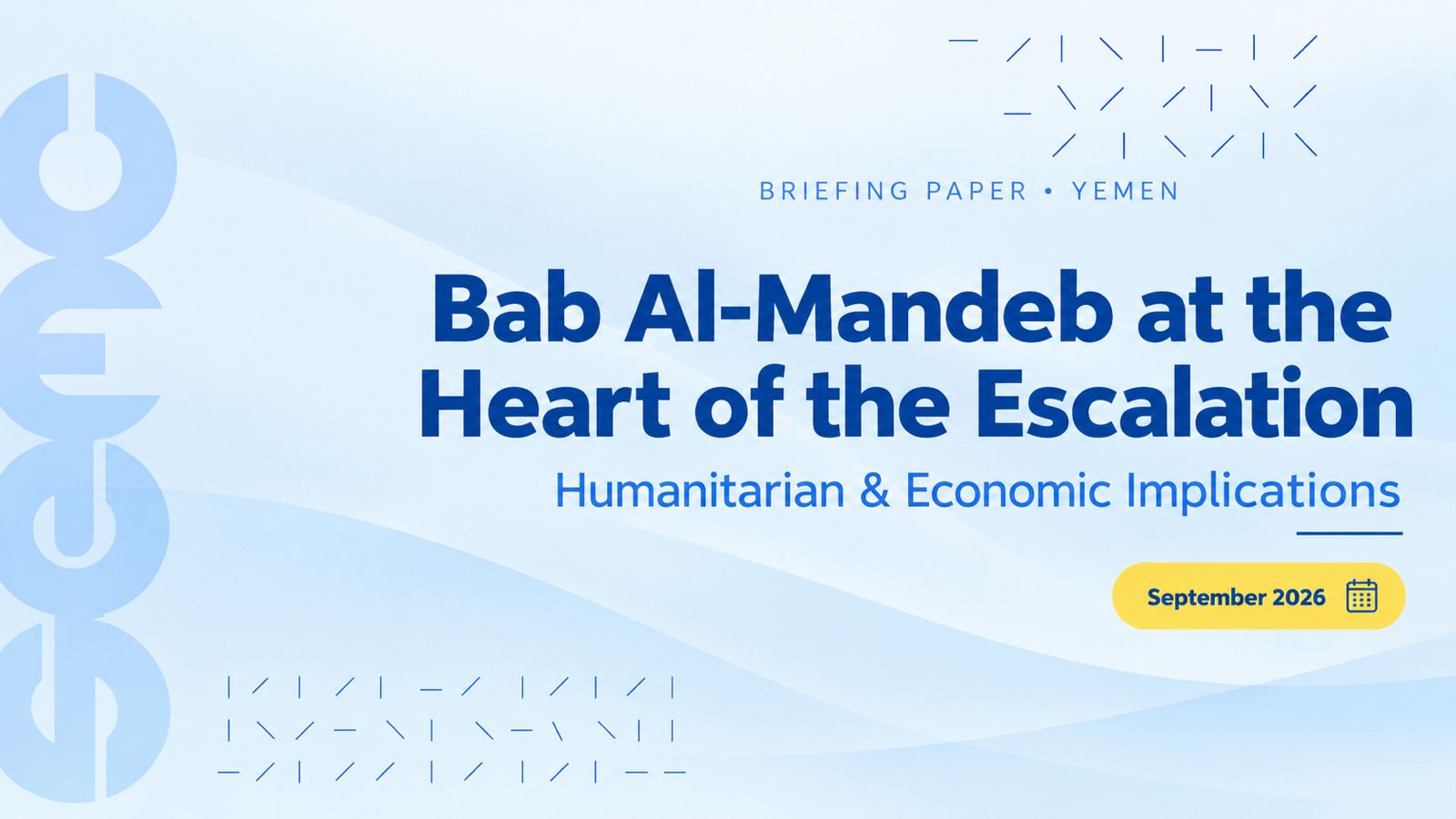
The warning came in a new briefing paper issued by SEMC entitled “Bab Al-Mandeb Strait at the Heart of the Escalation: The Economic and Humanitarian Implications of Houthi Control over a Lifeline of Trade in the Red Sea.” The paper examines what it describes as a “compound humanitarian and economic shock” affecting households, traders, financial institutions, fishermen, farmers, and humanitarian organizations.
According to the paper, the International Organization for Migration (IOM) recorded more than 104,000 displaced people from Taiz, Lahj, and Hodeidah since the beginning of September, while SEMC’s field estimates indicate that the actual number has exceeded 120,000 people, as thousands of families have moved in with relatives and therefore do not appear in displacement camp records. Available information also indicates that around 3,800 people crossed into Djibouti within three days following the latest developments.
The paper highlights the direct impact of the developments on humanitarian operations. SEMC documented the raiding and looting of premises and facilities belonging to local and international organizations, including the seizure of office equipment, computers, communications devices, operational equipment, components of solar power systems, and vehicles. SEMC noted that the impact extends beyond material losses to weakening organizations’ operational capacity, suspending or scaling back some activities, complicating access to beneficiaries, and forcing aid providers to reconfigure aid-delivery mechanisms at a time when the needs of displaced and affected communities are increasing.
On the economic front, SEMC documented the closure or slowdown of operations at a number of commercial establishments, the departure of some traders and money exchangers, and the transfer of part of the available liquidity to other areas, alongside declining buying and selling activity, transportation, and supply-chain operations. SEMC also documented the looting of commercial agencies, shops, and private property, as well as raids and arrests affecting some traders and residents in Mocha and Al-Khawkhah, prompting a number of business owners to keep their shops closed or reduce their operations.
SEMC noted that the change in control has also caused monetary and financial disruption as a result of the sudden transition between two distinct monetary regimes, contributing to a liquidity crisis and the emergence of an informal currency-exchange market with varying exchange rates, threatening to erode savings and business capital.
Banks, exchange companies, and money-transfer networks have also been affected. Some institutions closed or transferred part of their liquidity to other areas, while some money-transfer networks faced difficulties continuing to operate under their previous mechanisms. This has affected households and traders who rely on remittances to meet daily needs and conduct routine transactions.
The paper warns that the consequences of the developments extend beyond the local economy, given the strategic importance of the Bab al-Mandeb Strait to international trade. It notes that continued escalation around the strait would lead to higher shipping and insurance costs and the rerouting of some vessels, with direct consequences for Yemen, which is heavily dependent on imports, including higher prices for food, fuel, transportation, and essential services.
SEMC also documented disruption to the sources of income of fishermen, daily-wage workers, and small traders, as well as impacts on fish landing centers, transportation, cold-storage facilities, and fish-marketing supply chains. Agricultural activities in Mawza, Al-Khawkhah, Hays, Dhubab, and Al-Wazi’iyah are also facing risks as a result of disruptions to roads and to collection, marketing, and export centers.
The paper outlines a number of possible scenarios for how the situation may develop in the coming period and examines the potential implications of each for displacement, economic activity, humanitarian operations, the financial and banking sector, as well as trade and maritime traffic through Bab al-Mandeb and the Red Sea.
The paper concludes that displacement, loss of livelihoods, the looting and closure of businesses, disruption to humanitarian operations, disruptions to money transfers and the banking sector, and growing risks to trade through Bab al-Mandeb are interconnected factors that, if they persist, could deepen humanitarian and economic vulnerability, increase the cost of living, and reduce the capacity of households and organizations to cope with the crisis.
One substantive editorial point remains: the article contains several precise current-event figures and claims—especially the 104,000, 120,000, and 3,800 figures, as well as documented raids, looting, and arrests. The translation is faithful to your Arabic text, but before publication I would separately audit the underlying sourcing and attribution of those claims, because that is the area with the greatest reputational risk, not the English wording itself.
read the full briefing paper

COMMENTS