The Studies and Economic Media SEMC (SEMC) has warned of a worsening economic and humanitarian crisis in Taiz city amid continued closures of roads leading to the city and disruptions to the flow of commercial and humanitarian supplies. The SEMC stressed that the limited improvement in the availability of essential goods witnessed in late October was not a sustainable recovery, but a temporary easing that quickly faded following the closure of the remaining roads in early November.
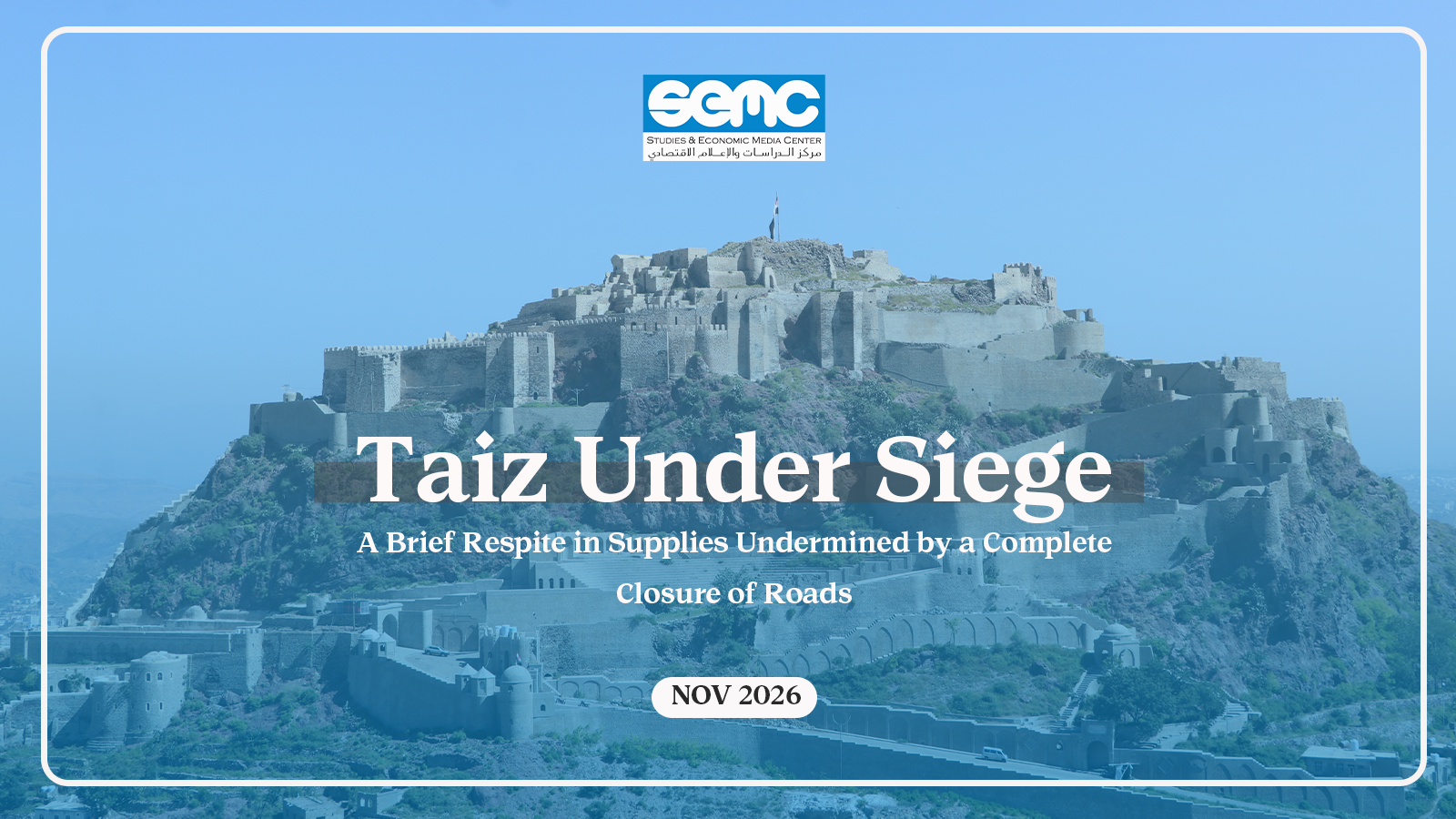
In its fourth briefing in a series of economic and humanitarian updates on Taiz, issued in November 2026, the SEMC explained that the city is facing an increasingly complex situation after all roads leading to it were closed, disrupting the regular flow of commercial supplies, driving up transportation costs, and widening shortages of essential commodities and fuel.
The briefing cited a November 2 statement by the UN spokesperson announcing that all roads leading to the city were closed due to fighting and that no commercial supplies were getting through. It also documented the reclosure of the Karbah–Al-Suhi road on November 6, after it had been reopened for only two hours, while the Haijat Al-Abd road has remained closed for more than a month.
The SEMC noted that official data reveal significant supply gaps in essential commodities, reaching 88% for rice, 61% for cooking oil and ghee, and 100% for meat, fish, and cheese. Supply gaps also reached 96% for gasoline, 98% for diesel, and 97% for domestic gas, according to data covering the period from October 1 to 20, 2026.
The briefing pointed out that the relative decline in prices of some food commodities during the final week of October did not restore prices to their pre-escalation levels. A 50-kg bag of flour remained priced at YER 46,500, compared with YER 38,000 before the latest military escalation. Meanwhile, prices of essential food items in the city have increased by at least 50% since the siege began, according to estimates by the UN Office for the Coordination of Humanitarian Affairs (OCHA).
Regarding fuel supplies, the SEMC explained that official petrol stations began selling gasoline on October 31 at YER 34,500 per 20-liter container, after prices on the black market had reached YER 55,000. However, this temporary relief did not last long due to the disruption of supplies. The SEMC also noted that the remaining diesel stocks in the city were estimated to be sufficient for less than 48 hours, according to media reports on November 4.
On the economic and livelihood front, data from the Taiz Office of Planning and International Cooperation revealed that more than 15,000 families had lost their sources of income due to the disruption of activities related to transportation, water, fuel, and services. In addition, 19 development projects had been suspended, 15 agreements or projects with international non-governmental organizations had been disrupted, 21 UN staff members had left the city, and the UN office had closed, while local revenues had fallen to almost zero.
Regarding essential services, the SEMC warned of a rapidly deteriorating situation in the water and health sectors, noting that water coverage in the city had fallen from 30% before the siege to just 8.2% afterward, following the shutdown of key wells and shortages of fuel needed to operate wells and water pumps.
SEMC also reported that between 550 and 600 tons of waste accumulate in the city every day, after sanitation trucks were unable to reach the main landfill outside the city since October 5. This has forced residents to burn waste in streets and residential neighborhoods, while more than 1,400 cases of acute watery diarrhea and suspected cholera were recorded in a single week.
In the health sector, the briefing reported that approximately 250,000 people had lost access to essential healthcare, while 12 hospitals and 18 health centers were at risk of reduced services or complete shutdown. The situation also poses growing risks to more than 1,110 patients dependent on dialysis, 192 intensive care patients, and 154 newborns in incubators due to shortages of fuel, medical supplies, and oxygen.
SEMC warned that continued road closures over the next two to four weeks could rapidly deplete the already limited stocks of essential commodities, push prices back to early October levels, and potentially bring water and healthcare services to a halt due to fuel shortages, unless arrangements are reached to ensure the regular and safe movement of supplies.
The SEMC called on the United Nations, the Office of the UN Special Envoy for Yemen, and the parties controlling the access routes to reach publicly announced and monitored arrangements to reopen roads leading to Taiz. It also urged the establishment of fixed crossing hours for commercial and humanitarian trucks, water tankers, and ambulances, and an end to practices requiring trucks to unload their cargo at crossing points.
It further recommended facilitating the transportation of existing fuel and gas supplies in Aden and Lahj, including approximately 1.5 million liters of gasoline, two million liters of diesel, and 52 LPG tankers, and ensuring their safe and regular delivery to the city. It also called for guaranteed diesel allocations for hospitals, dialysis centers, water wells, and sanitation vehicles.
The SEMC stressed the need to address the waste crisis and secure alternative disposal sites, link cash assistance programs to measures that increase the availability of commodities and monitor prices and stocks, support families that have lost their sources of income and affected small businesses, and resume suspended development projects.
The Studies and Economic Media SEMC emphasized that any improvement in Taiz’s economic and humanitarian conditions remains contingent on lifting restrictions on access roads and restoring the regular flow of goods and services. It warned that continued closures are turning the crisis from a temporary supply disruption into a rapidly escalating collapse of the city’s essential services and basic living conditions.
Read the full briefing

COMMENTS