The Studies and Economic Media Center (SEMC), through its Hakika Fact-Checking Platform and in partnership with the Yemeni Media Freedoms Observatory (Marsadak), organized a discussion webinar on Thursday, 18 June 2026, entitled “Hate Speech and Disinformation in Yemen: How Can We Counter Incitement?” The event brought together around 30 journalists, human rights activists, fact-checkers, and media students from across Yemen, coinciding with the International Day for Countering Hate Speech.
Moderated by broadcaster and TV presenter Nidal Al-Shaban, the webinar explored three main themes: the role of the media in countering hate speech, the legal and human rights dimensions of hate speech, and the relationship between disinformation and hate speech and their impact on social cohesion.
In the first session, journalist Zakaria Al-Kamali, founder of the Yemeni Windows platform and Director of Rights and Freedoms at the Yemeni Journalists Syndicate’s Taiz branch, discussed the responsibility of media outlets and journalists in confronting hate speech and incitement. He emphasized the importance of adhering to professional standards and ethical journalism, particularly in fragile and conflict-affected environments, and highlighted the media’s role in fostering social understanding rather than reinforcing divisions.
Al-Kamali stated: “Media platforms that adopt and promote hate speech to new audiences bear part of the responsibility for undermining social peace. We therefore need a comprehensive national code of ethics to confront this discourse, one that begins with the media and extends to the family, schools, Friday sermons, and mosques.”
Lawyer and human rights activist Omar Al-Humairi addressed the legal and human rights framework governing hate speech and the limits of freedom of expression, as well as the relevant national legislation and international conventions.
Al-Humairi said: “This is an ideal opportunity to raise our voices and call for official action against everything that fuels hatred, disturbs public order, and risks creating social divisions with serious consequences. Our legal framework already contains clear provisions and legislation that must be effectively enforced to curb the escalation of hate speech and incitement campaigns.”
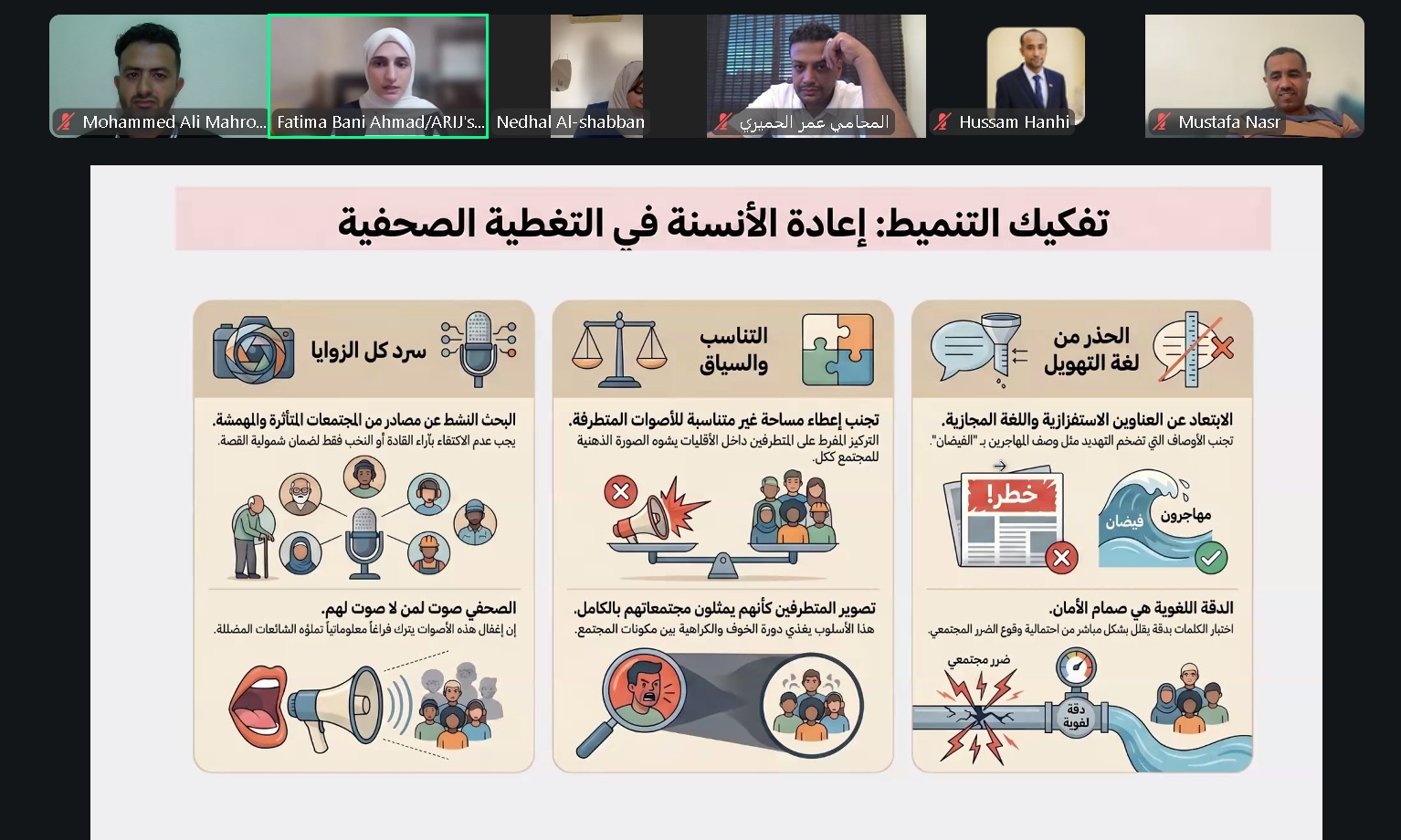
The practical training session was delivered by Fatima Bani Ahmed, Senior Fact-Checker and Project Specialist at ARIJ. She examined the relationship between disinformation and hate speech, introducing participants to the concept of “information disorder” and its three categories: misinformation, disinformation, and malinformation. She explained how misleading content can evolve into a tool for incitement and the exacerbation of social divisions.
Bani Ahmed also engaged participants in discussions based on practical fact-checking examples published by the Hakika platform, the Arab Fact-Checkers Network (AFCN), and ARIJ. The session included interactive exercises on distinguishing between misleading news, biased narratives, and inciting content, as well as practical methods for verifying claims before sharing or engaging with them.
For his part, Mustafa Nasr, Chairman of the SEMC, stressed the importance of organizing such events amid the challenges facing Yemen. He noted that the spread of hate speech and disinformation has become a direct threat to social peace and to citizens’ right to access reliable information.
Nasr stated: “Marking the International Day for Countering Hate Speech provides an important opportunity to raise awareness among journalists, media professionals, and content creators about their responsibility in reducing incitement and division. Building professional and responsible media is one of the most effective tools for protecting society and strengthening social cohesion in Yemen.”
The webinar concluded with an interactive discussion in which participants examined the most prominent manifestations of hate speech in Yemen’s digital space and explored ways to strengthen partnerships among media organizations, fact-checking platforms, and civil society organizations to combat disinformation and incitement while promoting a culture of dialogue and tolerance.
COMMENTS